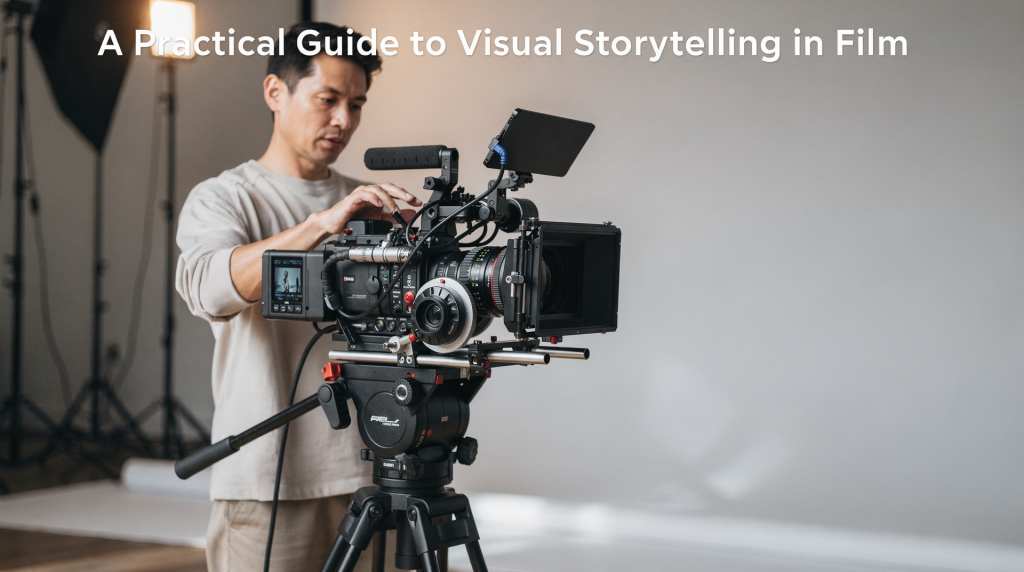
Visual storytelling is what turns a sequence of shots into a film with meaning. It is the practice of using framing, movement, light, color, composition, and editing to communicate emotion and information without relying on dialogue to do the heavy lifting. For filmmakers working in architectural and real estate spaces, this skill matters even more. Buildings do not perform like actors, so the story has to come from how you reveal scale, texture, flow, light, and human presence inside the space.
What Visual Storytelling Actually Means
At its core, visual storytelling is about making every image do a job. A shot should not just look good; it should reveal something about the subject, the mood, or the relationship between people and place. When I set up a frame in a quiet residential interior, I’m not just looking for a pretty angle. I’m asking: what does this space want to say about itself? Is it the way the late afternoon light falls across a stone floor, or the sightline from the entryway that pulls you inward? That intention is what separates a visual story from a series of nice stills.
A strong visual story usually answers at least one of these questions:
- What is this space or subject like?
- How does it feel to be here?
- What matters most in this moment?
- What changes from one shot to the next?
That is why the best visual storytelling often feels simple. The audience is not being told what to think. They are being guided to feel it. When the edit flows and the camera movements feel inevitable, you’ve done the work without showing the seams.
The Core Building Blocks
Film storytelling through visuals usually depends on a few essential elements: framing, lighting, camera movement, color, composition, and editing. Each one shapes meaning in a different way, and in architectural work they rarely operate in isolation. For example, a slow push-in only works if the composition is strong enough to support the move, and a warm interior palette gains depth when the lighting sculpts the walls rather than flattening them. Here is how these elements function in practice.
| Element | What it does | Practical use |
|---|---|---|
| Framing | Controls what the viewer sees and what gets excluded | Isolate a subject, emphasize scale, or hide distractions |
| Composition | Organizes visual attention | Use leading lines, balance, and negative space to guide the eye |
| Lighting | Creates mood and dimension | Make a room feel warm, stark, spacious, or intimate |
| Camera movement | Adds energy or reveals information | Push in for emphasis, track to reveal a layout, hold steady for calm |
| Color | Supports tone and emotion | Use warm tones for comfort, cool tones for restraint, or contrast for tension |
| Editing | Controls rhythm and meaning | Cut fast for urgency, slow for elegance, or place shots in contrast for subtext |
Start With the Story You Want to Tell
Before shooting, define the emotional goal. A visual story is not just a collection of attractive images; it is a sequence built around intent. When a client asks me to film a renovated loft, my first question is never “what are the features?” It’s “what should someone feel when they watch this?” That answer drives every technical decision downstream.
Ask these questions:
- What should the viewer feel first?
- What should they notice second?
- What details prove the point?
- What is the final impression?
For architectural and real estate work, this often means choosing a narrative angle such as:
- heritage and craftsmanship
- openness and flow
- luxury and restraint
- warmth and livability
- urban energy and scale
- transformation and renewal
Once that angle is clear, every shot becomes easier to choose. You stop collecting random coverage and start building a sequence that has a point of view.
How to Build a Visual Story Shot by Shot
1. Begin with establishing context
Start by showing where we are. A wide shot gives the viewer orientation and sets up the scale of the environment. In architecture, this is often the exterior, the approach, or a wide interior that explains how the space is organized. I almost always open with a view that grounds the viewer — a drone pull‑back from the street, a slow pan across a facade, or a static wide from the entry that shows the main volume of the room. Without that anchor, everything else feels disconnected.
Good establishing shots answer:
- Where is the viewer?
- How large is the space?
- What is the architecture’s character?
2. Move from wide to specific
A useful storytelling pattern is to start broad and gradually move tighter as the scene develops. This mirrors how people naturally experience spaces: first the whole environment, then the details. When I cut from a wide living room to a medium shot of the kitchen island and then to a close‑up of the marble veining, I’m not just showing things — I’m leading the audience through the way someone might actually notice the space. The sequence becomes an act of discovery.
In practice:
- Wide shot: the whole room or building
- Medium shot: a key zone or relationship between spaces
- Detail shot: material texture, hardware, or light on a surface
This progression creates visual logic and helps the audience feel that they are entering the space instead of just observing it.
3. Reveal information with movement
Camera movement should feel motivated. In other words, the move should reveal something new or strengthen the emotion of the shot. A slow push‑in toward a window seat works because it suggests that this spot matters — it’s not just a move for the sake of motion. A tracking shot along a hallway creates flow and lets the architecture unfold naturally. A pan up a double‑height stairwell reveals vertical scale that a static shot can only hint at. I rarely use handheld for luxury interiors; it introduces a nervous energy that fights the calm the spaces usually demand. But for an active construction site or a bustling commercial space, a bit of handheld can add the right amount of urgency. The key is control: if a move doesn’t add information or emotion, it’s better to hold still.
Useful moves for storytelling:
- Slow push-in: builds anticipation or highlights importance
- Tracking shot: creates flow and proximity
- Pan or tilt: reveals layout or vertical scale
- Handheld movement: adds instability or urgency
For interiors, movement should usually be controlled and readable. Tight spaces punish random motion. Clean movement tells the viewer that the space is intentional, not chaotic.
4. Let light do part of the writing
Lighting is one of the fastest ways to shape meaning. The same room can feel calm, dramatic, sterile, or intimate depending on how it is lit. When I light a kitchen for a real estate film, I’m not just making it bright. I’m thinking about where the shadows should fall, what surfaces should catch a specular highlight, and whether the color temperature matches the natural light coming through the windows. Soft, even light from a large diffusion panel makes a space feel open and serene. A harder directional source raking across a brick wall brings out texture you’d never notice on a flat pass. Backlight separates a chair or a plant from the background and adds depth. And shadows — especially in a moody study or a bathroom with a single window — can make a space feel private and refined. Natural light is almost always the most believable foundation. The trick is not just to make the room bright, but to make the light feel true to how the eye would see it.
Simple lighting choices change the story:
- Soft, even light suggests calm and openness
- Directional light adds texture and contrast
- Backlight can separate a subject from the background
- Shadow can make a space feel private, moody, or refined
Composition Choices That Strengthen Story
Composition is not decoration. It is how you tell the viewer what matters most in the frame. In architectural shooting, the building already gives you strong lines, frames within frames, and negative space. Your job is to recognize them and use them with intent.
Use leading lines
Hallways, railings, countertops, and window frames can guide the eye toward a subject or destination. In architecture, leading lines are especially powerful because the built environment already contains them. A long corridor that pulls the eye toward a sunlit patio tells a story about indoor‑outdoor flow without a single word. I often line up the edge of a kitchen island with the far window so the viewer’s gaze travels naturally through the space.
Use negative space with purpose
Empty space can make a room feel elegant, minimal, or expansive. It can also isolate one important object or detail. A wide shot with a single chair in a large, uncluttered living room says something very different from the same chair surrounded by busy furniture. Negative space gives the subject breathing room and tells the audience where to look. I use it most when I want to emphasize a material or a specific architectural gesture — a lone pendant light over a dining table, or a single window in a bare plaster wall.
Use symmetry carefully
Symmetry can suggest order, stability, and formality. It works well in staircases, facades, and carefully designed interiors. A perfectly centered shot of a symmetrical facade communicates strength and intention. But too much symmetry, especially in a long edit, can make a scene feel static if there is no contrast or movement. I’ll often break a symmetrical sequence with an off‑center detail or a lateral move to keep the rhythm alive.
Frame through architecture
Doorways, windows, and arches create natural layers in the image. They add depth and help the viewer feel that the camera is discovering the space rather than flattening it. Shooting from one room through a doorway into another is a classic architectural perspective. It gives you foreground, middle ground, and background all in one frame, and it invites the viewer to imagine moving from one space to the next.
Editing Is Where Meaning Locks In
Editing is not only about pacing. It is where the emotional shape of the story becomes clear. In architectural films, how long you hold a shot and what you place next to it can completely change the perception of a space. A quick succession of detail shots can feel energetic and modern; long, quiet holds can feel contemplative and luxurious. Both are valid — it depends entirely on the story you set out to tell.
Fast cuts
Fast pacing creates urgency, energy, or compressed time. This works for dynamic urban sequences, active environments, or short promotional work. For a city‑focused real estate piece, I might cut between traffic, pedestrians, shopfronts, and building exteriors every second or two. The rhythm becomes part of the message: this place is alive.
Slow cuts
Longer holds give the image room to breathe. This is better for elegant interiors, calm documentary work, or spaces where texture and atmosphere matter. A luxury penthouse should not feel rushed. I’ll often hold a wide shot of a living room for five or six seconds, letting the viewer settle into the space before moving on. The length of the shot suggests confidence and calm.
Juxtaposition
Placing contrasting shots next to each other creates meaning. A wide exterior followed by a tight detail shot can suggest grandeur plus craftsmanship. A pristine room followed by signs of lived-in use can suggest warmth and humanity. I use this a lot when I want to show both the scale of a building and the tactile quality of its materials — the viewer feels the big gesture and then the intimate one, and the contrast makes both stronger.
Match rhythm to subject
A luxury penthouse, a historic home, and a busy street-level commercial interior should not cut the same way. The edit should reflect the personality of the space. A mid‑century modern house with clean lines and large glass walls calls for measured, deliberate cuts. A lively restaurant or a boutique hotel lobby can handle a faster, more syncopated rhythm. Matching cut pace to the architecture’s inherent tempo is one of the most effective ways to make a film feel intentional rather than assembled.
Visual Storytelling in Architectural and Real Estate Film
This is where general film technique becomes especially practical. Buildings are not just backgrounds. They are environments that shape behavior, memory, and mood. The story often lives in the relationship between the person and the space. You are not filming a property; you are filming the feeling of being inside that property.
What to emphasize in architectural storytelling
- scale
- texture
- flow
- light quality
- material detail
- transition between rooms
- the way the space is used
For a dedicated architectural film, I spend more time on material close‑ups and how light moves across surfaces. A concrete wall is not just a wall — it has grain, color shifts, and shadows that change throughout the day. Showing those details gives the building a tactile presence.
What to emphasize in real estate storytelling
- livability
- circulation
- comfort
- natural light
- function
- emotional appeal
- sense of value
Real estate films are often more about the future occupant than the building itself. I still shoot the architecture, but I look for moments that suggest life: a breakfast nook with morning light, a bathroom with a freestanding tub, a home office with a view. The most effective real estate films do not just list features. They help viewers imagine themselves there.
A Practical Workflow for Planning a Visual Story
Step 1: Define the message
Write one sentence that describes the feeling or idea. This becomes your north star for every shot. Examples:
- A mid-century home that feels calm, rooted, and architectural
- A downtown loft that feels open, industrial, and energetic
- A historic residence that feels layered, elegant, and preserved
If a shot doesn’t serve that sentence, it doesn’t belong in the film.
Step 2: Break the space into story beats
Think of the film as a sequence:
- arrival
- orientation
- discovery
- detail
- emotional payoff
These beats give you a structure. The arrival might be the street approach or the entryway. The emotional payoff might be a sunset view from the main living space or a quiet moment in a garden. Everything else supports the path between them.
Step 3: Build a shot list around those beats
Every shot should support one of the story beats. If it does not, cut it. I always number my shots and note which beat they serve. That keeps me honest on set when time is short and I’m tempted to grab extra coverage that looks nice but doesn’t advance the story.
Step 4: Match technique to intent
- Use wide shots to establish space
- Use movement to reveal
- Use close details to create intimacy
- Use light to set tone
- Use editing to control pace
This is where the earlier building blocks come together. A slow push‑in on a staircase only makes sense if the story beat is about arrival or ascent. A quick cut to a door handle makes sense if you’re emphasizing craft.
Step 5: Review the sequence without sound
If the story still makes sense mute, the visuals are doing their job. I do this on every edit. Turn off the music and VO, watch the sequence, and ask: can the viewer follow the space and the feeling without any explanation? If yes, you’ve built a strong visual narrative. If not, you’re covering gaps with sound.
Common Mistakes That Weaken Visual Storytelling
- Shooting only for beauty and forgetting narrative purpose
- Using too many camera moves without a reason
- Over-lighting interiors until they feel flat
- Cutting every shot at the same pace
- Ignoring transitions between rooms or spaces
- Treating detail shots as filler instead of meaning
- Showing too much too early and removing tension or discovery
One of the biggest mistakes is assuming that more coverage equals better storytelling. In reality, stronger storytelling usually comes from clearer intent and tighter selection. I’ve watched editors drown in footage because the shooter grabbed everything. The best footage is the footage you know you need before you press record.
A Simple Checklist Before You Shoot
- Do I know what this film is trying to make the viewer feel?
- Does each shot reveal something new?
- Am I using movement with purpose?
- Do the lighting choices support the mood?
- Is there a clear visual progression?
- Are details included because they matter?
- Does the edit rhythm match the subject?
If the answer to most of these is yes, the film will likely feel intentional. I keep this list on my phone and run through it before every architectural shoot. It takes two minutes and saves hours in the edit.
A Useful Way to Think About Space on Camera
For cinematic space work, the location is not just a set. It is the subject. That means the camera should behave like a curious observer.
A strong visual story in architecture often feels like this:
- enter the space
- understand its structure
- notice its character
- discover its details
- leave with a clear emotional impression
That approach turns a room, house, or building into something more than a property tour. It becomes a narrative experience. I think of the camera as the viewer’s proxy — its movements and framing should mimic the way a person would naturally look around if they were standing there for the first time, curious and unhurried.
Conclusion
Visual storytelling in film is the disciplined use of image, movement, light, composition, and editing to communicate meaning. When it is done well, the audience understands the story before it is explained. For architectural and real estate filmmaking, this means treating every space like a subject with its own mood, rhythm, and point of view. If you know what the space should feel like, and you choose every shot to support that feeling, the film will start to speak for itself.
FAQ
What is visual storytelling in film?
Visual storytelling is the practice of conveying emotion, character, and meaning through images instead of relying on dialogue. In architectural work, that means letting the wide shot establish scale, the close‑up reveal texture, and the movement guide the viewer’s emotional response — all without a single spoken word.
Why is visual storytelling important?
It helps the audience understand the story faster and feel it more deeply, especially in film where images, movement, and editing shape meaning. A well‑crafted visual sequence can make a viewer feel the calm of a sunlit room or the energy of a busy street before they can articulate why.
What are the main elements of visual storytelling?
The main elements are framing, composition, lighting, camera movement, color, and editing. Each one plays a distinct role, and when they align, the film feels unified and purposeful rather than like a collection of disconnected shots.
How do I make a space feel cinematic?
Use controlled movement, purposeful composition, layered lighting, and a clear shot progression from wide context to meaningful details. Think about how a person would actually experience the space, then let your camera guide them through that experience. Avoid unmotivated moves and flat, uniform lighting — those are the fastest ways to kill a cinematic feel.
What is the biggest mistake beginners make?
They often focus on attractive shots without building a visual sequence that actually tells a story. A beautiful frame is only valuable if it contributes to the emotional journey. Without that, the film becomes a slideshow of pretty images instead of a narrative.