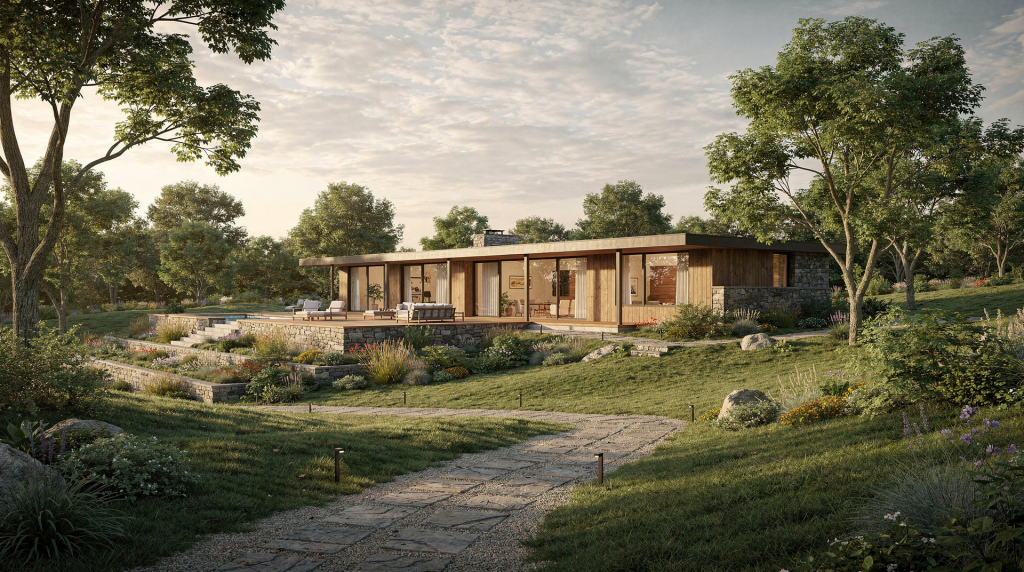
A house on a blank background is a diagram. A house nestled into its terrain — that’s a story. Early on, I shot a modernist pavilion perched on a hillside and made the rookie mistake of framing it tight, as if the architecture existed in a vacuum. The result felt claustrophobic, dishonest. The lesson stuck: a building reveals itself fully only when you show what it pushes against and what it opens toward. This project was built around that conviction — not just documenting a beautiful house, but capturing how it breathes with its surroundings.
Why the Landscape Matters in Architectural Film
Most real estate filmmakers treat the exterior as an obligation: a few establishing shots, a drone orbit, then straight inside. It’s a rhythm born from efficiency, not storytelling. But that approach squanders one of the richest narrative assets a property can offer — the dialogue between built form and land.
When the landscape earns its place in the edit, the film shifts. The viewer stops cataloguing rooms and starts absorbing an atmosphere. A well-shot exterior sequence grounds the property in reality. It answers questions the interior alone never can: How big is the lot really? Does the house feel private or exposed? What does the light do in the afternoon? These aren’t decorative details — they shape the emotional experience of a place before anyone steps through the door.
Professionally executed exterior coverage works on three levels simultaneously. It communicates scale — a wide frame with a mature oak beside the facade tells you more about proportion than any floor plan. It establishes context — showing whether the home commands a ridge or tucks into a hollow. And it injects emotional tone — stillness for a secluded retreat, sweeping motion for a coastal estate. When a property offers courtyards, patios, layered gardens or borrowed views, the footage needs to treat those elements not as bonus features, but as primary assets. Buyers aren’t just paying for square footage; they’re investing in a rhythm of living.
The Core Story: Architecture as Part of the Site
The mental model that unlocks this kind of cinematography is deceptively simple: stop separating “house shots” from “yard shots.” The moment you categorise them differently, you introduce a visual seam the viewer will feel. Instead, think in terms of relationships that span the threshold.
I start every such project by mapping four key relationships the camera needs to capture. First, the approach — the sequence of frames that leads a viewer from the street or lane into the property’s world. A driveway reveal through overhanging branches works differently than a sudden clearing, and both feel different from an urban entry sequence with a courtyard. Second, the transition from public to private — that gradient of enclosure where landscaping, gates, walls and entry architecture negotiate between outside and inside. Third, the way the structure frames the outdoors — windows, sliding doors, deep eaves and colonnades that turn landscape into living artwork. And fourth, the way the exterior reflects back through interiors — light falling through leaves onto a floor, the colour of stone echoed in a kitchen backsplash, the sound of water from a courtyard fountain occupying a silent hallway.
When a home has strong indoor-outdoor flow, the coverage must make those connections visible and almost tactile. Wide shots establish the physical relationship between interior volume and surrounding land. Close-ups on thresholds — door tracks, sill details, fabrics moving in a breeze — convey texture. Outdoor footage that carries its own narrative arc expands the story beyond walls. The goal is a film where the building and its site feel inseparable.
Planning the Shoot: What to Look For Before Pressing Record
A camera operator sees angles. A director reads a site. Before I unpack gear, I walk the property slowly — at least twice. Once for light, once for movement. On the first pass, I’m watching where sunlight lands at that hour and predicting how it will travel. On the second, I’m feeling how the spaces pull me through them, where I pause naturally, where my eye lands.
Key questions to ask on location
- Where does the eye go first upon arrival? That’s your opening frame.
- Which facade holds the strongest light, and when? This determines schedule.
- What outdoor areas feel like a destination rather than leftover space? A terrace with chairs, a bench under a tree, a deck at the cliff’s edge — these are set pieces, not background.
- Which specific view or moment explains the home’s relationship to its setting better than any other? Find it and build the edit around it.
- Where do architecture and landscaping feel most like they were designed together? That intersection is visual gold.
If the answer points to a back porch facing a garden, then that garden isn’t scenery. It’s a character. Treat it with the same compositional rigour you’d give a hero living room — perhaps more, because natural settings change with light and weather in ways interiors don’t.
A Practical Shot Strategy for Home-and-Landscape Films
Over dozens of these projects, I’ve settled into a narrative cadence that moves from context to intimacy and back out again. It’s not a formula, but a reliable backbone you can adapt to the property.
1. Establish the setting
Open with the home in relation to its environment — wide enough that the viewer understands terrain, scale, and placement. This might be a drone shot sweeping up a valley, a slow lateral reveal through trees, or a carefully composed static wide that lets the architecture settle into the frame. The opening should feel like an arrival, not a title card. Exterior-first storytelling anchors the viewer geographically and psychologically before they enter.
2. Show the threshold
Threshold zones are the most underfilmed spaces in architectural video and arguably the most important. They’re where the building meets the earth — front steps worn by decades of use, entry paths cutting through native planting, terraces that extend living space outward, covered porches that blur the line, sliding doors that turn walls into apertures, courtyard gates, deck edges, pool coping. These transitions define how a home feels when you move through it. Skip them, and the edit feels like a series of disconnected rooms.
3. Capture the interior with exterior awareness
Interiors shouldn’t feel like sealed boxes. Use windows as composition anchors — place your camera so a window reveals a meaningful slice of outside, not a sliver of fence. Frame doorways so the landscape reads beyond. Use reflections in glass, polished floors, or dark surfaces to echo the exterior. Window frames and door openings are the most honest compositional devices you have; when the view is a genuine asset, let it dominate a portion of the interior frame. Let the viewer feel they’re inside, but never cut off from the land.
4. Return to the outside
End with release. After a sequence of interiors, step back out — a patio at dusk catching the last warmth, light raking across the facade, wind animating the canopy, a wide frame that rests the house gently in its landscape. This final beat signals completeness. It says: this isn’t just a building, it’s a place within a larger world.
Composition Techniques That Work Especially Well
Landscape-centered property films reward discipline. Visual complexity for its own sake distracts; clarity serves the story. The techniques below are tools I reach for repeatedly — not because they’re clever, but because they reliably translate spatial relationships to a flat screen.
| Technique | Why it works | Best use case |
|---|---|---|
| Rule of thirds | Places the home or horizon on one of the frame’s natural tension points, giving the landscape room to breathe and the composition a satisfying balance. Off-center placement often reads as more intentional and less brochure-like. | Wide exterior shots, view reveals, any frame where sky and land share significant real estate |
| Leading lines | A pathway, a low stone wall, a line of trees, the edge of a pool — these pull the viewer’s eye toward the home or into the landscape with an almost physical momentum. They create depth and direction without needing camera movement. | Driveways, paths, retaining walls, rows of planting, boardwalks |
| Framing | Using foreground elements — tree branches, archways, door openings, window mullions — to enclose the subject makes the relationship between architecture and site feel deliberate and layered. It also adds a sense of discovery, as if the viewer is looking through something rather than at something. | Porch views outward, interior-to-exterior shots through doors, garden views filtered through structure |
| Symmetry | Centered, balanced composition underscores formality and architectural intent. It works especially well for front elevations and entry sequences where the goal is presence, not atmosphere. | Front elevation, formal entries, aligned axes through the house |
| Depth layers | Stacking foreground, midground, and background elements creates dimensional staging that makes the viewer feel present in the scene. A branch in the foreground, the house in the midground, mountains behind — that layering is what distinguishes a still from a set decorator’s catalog. | Foreground planting, midground structure, background view or sky |
A simple rule for outdoor compositions
If the landscape genuinely adds value, let it claim space in the frame. The most common composition error I see is crowding the home against the edges of the image, as if terrified of empty space. An expansive garden, a ridgeline vista, a courtyard — these need room to perform. Let the house occupy its portion, and let the site hold the rest. The viewer will feel the relationship, not just catalogue an object.
Lighting Considerations: Let the Site Tell You When to Shoot
The best lighting schedule isn’t determined by personal preference — it’s dictated by how the property faces and what the landscape demands. A home that glows at golden hour on one facade might sit in harsh shadow on another. Your job is to map that early and build the day around it.
Morning light
Morning delivers soft, low-contrast illumination with cool colour temperatures. It’s the premier choice for east-facing facades, gardens wet with dew, and properties where you want the landscape to feel crisp, fresh, and calm. Morning light carves gentle shadows that add dimension without drama. I often schedule east-facing exteriors and garden close-ups in the first two hours of daylight, then move inside as the sun climbs.
Midday light
Harsh, vertically cast, unforgiving on faces — but useful when you need even, shadow-free coverage of a building’s form or when shooting in densely shaded landscapes where softer light would lose visibility. I reserve midday for practical documentation: layout shots, drone surveys, coverage of shaded courtyards that read better under direct sun. If you must shoot exteriors at noon, lean into graphic compositions and geometric shadows cast by hard light; they can become intentional rather than accidental.
Golden hour and twilight
The warm, directional light of golden hour makes materials glow — timber, stone, render, water. It’s the most emotionally charged light for exterior sequences. Pools catch colour, facades develop depth, landscapes look inhabited rather than observed. Twilight extends that window when the property has its own lighting — path lights, uplighting on trees, pendants on a porch, a lit pool. That’s when the architecture becomes luminous. Twilight shoots require planning: the window of balanced exposure between ambient sky and artificial light is narrow, often 15 to 25 minutes. Arrive early, compose, wait for the moment.
Movement: How to Move the Camera Without Losing the Relationship
Camera movement in architectural film has one job: to reveal. It should feel like the property is unfolding, not like the operator is wandering.
Effective movements
- Slow lateral slides — a horizontal tracking motion that reveals the home against its landscape one element at a time. This works brilliantly when the house extends along a contour line or when a garden unrolls alongside a facade.
- Gentle push-ins — deliberate forward movement toward an entry, a terrace edge, or a framed view. This creates anticipation and directs attention without announcing itself.
- Controlled follow shots — moving along a path or driveway at a measured pace, as if walking with the viewer. The key is consistency: no sudden speed changes, no wandering focal points.
- Static holds — when the composition already communicates everything it needs to, don’t move. Lock the camera and let the viewer’s eye explore. A long static frame of a house settling into its landscape often carries more weight than any movement could.
Movements to avoid
- Fast pans that smear the landscape into a blur — they strip away texture and flatten depth.
- Gimbal work that floats without purpose — smooth motion that doesn’t direct the eye is still wasted motion.
- Random walk-throughs with no visual logic — the camera should move because something is being revealed, not because it can.
- Drone overuse — aerial footage that circles endlessly without adding information makes the house feel untethered, not elevated. A drone should explain terrain, siting, or context; once it has, land it.
A property film should feel directed, as if someone made deliberate choices about sequence and pacing. The strongest walkthroughs lead the viewer through a logical flow — entrance, main spaces, outdoor areas — without rushing or meandering.
The Difference Between Showing a House and Showing a Place
This distinction is the creative watershed. A video that shows a house answers one question: what does this property look like? A film that shows a place answers three: what does it feel like to live here, how does this building belong to its site, and what kind of daily life does this setting support?
Those questions change everything about how you shoot. A polished kitchen detail is useful; a kitchen that opens onto a terrace where morning light lands on a wooden table is evocative. The first is information. The second is atmosphere. Information is forgettable. Atmosphere lingers.
I’ve shot living rooms that faced mature oaks through floor-to-ceiling glass, and the most powerful frames weren’t the wide interiors — they were the shots where you could see both the room and the trees reflected in the same glass, the interior and exterior occupying a single image. Those frames suggest rhythm — the quiet of a morning, the shade through the afternoon, the long view at dusk. They hint at inhabitation, not just architecture. That’s the layer of meaning a landscape-conscious approach adds.
Common Mistakes When Filming Homes With Strong Outdoor Context
1. Treating the exterior as filler
The garden, yard, or view is often a significant portion of a property’s value. It needs intentional coverage — planned shots with composition, light, and movement, not a handful of clips grabbed on the way back to the car.
2. Ignoring transitions
Homes connect to their landscape through thresholds. Ignore the doorways, steps, paths and porches, and you lose the physical logic of how the place works. The sequence should include moments between spaces, not just the spaces themselves.
3. Overexposing the view
A blown-out window in an otherwise beautiful interior shot severs the connection between inside and outside. When the view is part of the story, protecting highlight detail in the exterior matters. Expose for the view and balance the interior, or bracket and blend — but don’t let the landscape become a white void.
4. Shooting only from eye level
Eye level is comfortable, but it’s rarely the most revealing angle for relationships between building and land. A camera positioned lower can emphasise the anchoring of a structure to the ground; a slightly elevated position can articulate the sweep of a garden or the geometry of a courtyard. Move the camera physically, not just through zoom or gimbal.
5. Forgetting the human scale
A stunning landscape without any hint of human presence can feel like a rendering, not a place. The suggestion of use — a single chair oriented toward a view, a dining setting on a deck, a worn path through grass — shifts the image from documentation to invitation.
On-Set Checklist for Home-and-Landscape Coverage
- Capture one wide establishing shot of the property in context — this is your anchor frame.
- Film the approach from the street, gate, or path — think arrival, not just location.
- Get at least one threshold shot connecting interior and exterior — doorway, sliding door, porch edge.
- Record multiple angles of patios, porches, decks, and courtyards — close and wide, static and moving.
- Include landscape details that communicate scale and mood — leaves, textures, planted beds, mature trees.
- Use windows and doors as composition devices to visualise the inside-outside relationship.
- Film the same area at different times of day if the light transforms the story — morning dew versus golden hour warmth on the same terrace.
- Save a final exterior shot that lands with intention — dusk light on the facade, a wide view settling the house into the terrain.
Best Situations for This Approach
This landscape-driven style isn’t for every property. A tightly packed urban townhouse with a postage-stamp yard won’t sustain it. But when the setting is a genuine asset, this approach pays for itself in emotional impact and buyer engagement.
It works exceptionally well for historic homes with established gardens — properties where decades of growth and care have created an environment that can’t be faked. Mid-century modern houses are natural candidates, as the whole design philosophy revolves around dissolving boundaries between inside and out. Coastal properties with open views demand it; the ocean or shoreline is so dominant that ignoring it would misrepresent the property entirely. Rural homes where acreage, woodland, or topography are central to the identity benefit enormously. Urban homes with thoughtfully designed courtyards, roof terraces, or internal gardens also reward the approach. And in the luxury segment, where the setting often rivals the finish level in importance, landscape-conscious filming separates premium marketing from standard listing video.
What This Kind of Film Delivers for Clients
A landscape-centered property film doesn’t just show amenities; it builds emotional logic around the purchase. It helps a potential buyer understand, almost intuitively, why this house sits where it sits and what living there would actually feel like day by day.
The return on that investment is tangible. Stronger perception of value — because the property feels complete rather than compartmentalised. Better memory retention — because atmosphere lingers longer than feature lists. Clearer grasp of layout and orientation — because the film visually maps the relationship between indoor and outdoor spaces. More, and more qualified, interest — because buyers who care about setting and lifestyle self-select when the film foregrounds those qualities.
When the landscape stops being decoration and becomes part of the sales narrative, the film does something a floor plan never can: it makes a viewer feel what it might be like to wake up, walk outside, and belong to a place.
Final Takeaway
If the architect and the landscape designer collaborated — even if one of them was nature — the film should honour that partnership. The most memorable architectural videos I’ve worked on all share one quality: they refuse to isolate the building from its land. They treat the exterior as equal partner, not backdrop. They let the house and the landscape speak to each other, and they’ve given the viewer a seat close enough to hear the conversation.
The next time you’re on site at a property with a meaningful setting, elevate the landscape from background to co-star. Shoot it with the care you’d give a hero interior. Build your edit around the relationship, not just the rooms. That’s where the footage stops being a walkthrough and starts being cinematic.
FAQ
How do you film a home and landscape together without making the video feel too wide or empty?
Layered composition is your best tool. Place something in the foreground — a branch, a wall edge, a piece of furniture — to create depth and frame the scene. Use measured, deliberate camera movement rather than static wides that can feel sterile. Mix establishing shots with medium frames and intimate details so the landscape never overwhelms. The trick is letting the site feel expansive without letting it dominate; the house should always remain the anchor point.
Should drone shots be used for this kind of project?
Absolutely, but with restraint. A drone is a contextual tool, not a storytelling crutch. A single, well-planned aerial sequence that reveals the property’s setting, lot proportions, or relationship to terrain is worth more than five minutes of orbiting footage. Use it to explain what ground-level cameras can’t — the approach from above, the coastline beyond the ridge, the way the house sits within its valley — and then bring the story back to earth. Drone footage that replaces ground-level human experience makes a film feel detached rather than inviting.
What is the most important shot in a home-and-landscape film?
Often it’s the establishing shot that places the home within its site — wide, considered, lit at the right time of day, with the landscape occupying meaningful real estate in the frame. This single image sets the tone for everything that follows. It tells the viewer: this isn’t just a set of rooms; this is a place in the world. If you nail that shot, the rest of the film has a foundation to build on.
How do you make outdoor areas feel as important as interiors?
Give them the same narrative weight you’d give a living room or kitchen. That means planned coverage, not leftover clips. Shoot them in flattering light — golden hour for warmth, twilight if there’s landscape lighting. Show how they connect to daily life: a patio door left open, a dining table set, a chair angled toward a view. Let the edit linger on outdoor spaces long enough for the viewer to imagine inhabiting them. If you treat them as afterthoughts, the viewer will too.
What is the biggest mistake people make?
Treating the landscape as background decoration rather than subject matter. If the setting is a genuine part of the property’s value — and in many cases, it’s the defining asset — it deserves the same intentional coverage, the same consideration of light and composition, and the same editorial prominence as any interior hero shot. When you relegate it to a few generic clips at the end of the edit, you’re leaving story on the table and underselling the property.