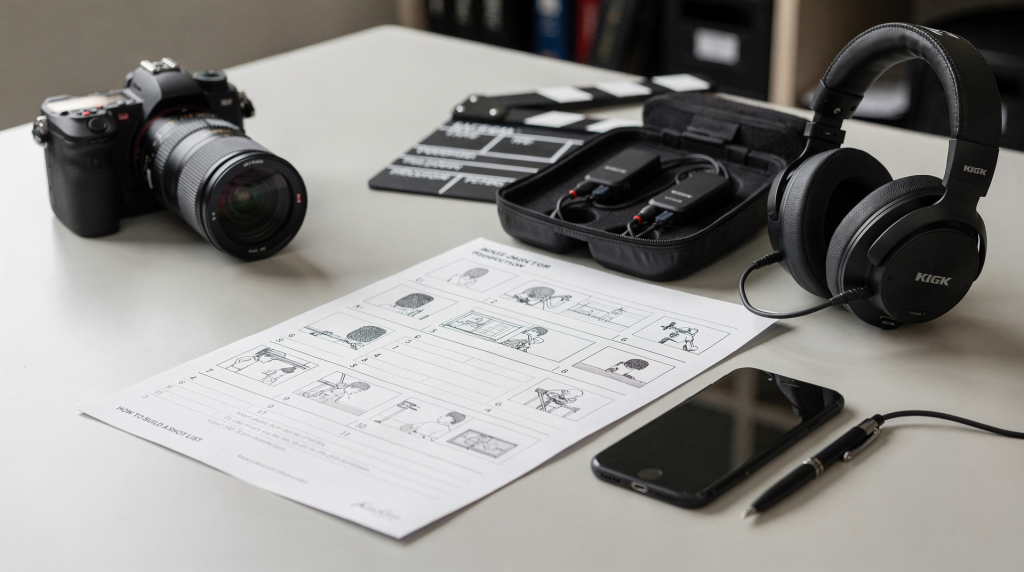
Most shoots don’t fail because of the camera. They fail because nobody agreed on what needed to be captured, in what order, and for what purpose. A strong shot list solves that before it costs you a location day. It turns a vague idea into an executable plan, keeps the crew moving in the same direction, protects the schedule, and gives the editor enough coverage to build pacing and continuity instead of scrambling for cutaways.
What a Shot List Is and Why It Matters
A shot list is not just a spreadsheet of angles. It’s a written plan of every shot you intend to capture—organized by scene, location, or story beat—and it functions as the production roadmap for the day. It answers four questions before anyone picks up a camera: what are we filming, where are we filming it, how is it framed, and what order makes sense on set.
In narrative and commercial work, a shot list solves three recurring problems. It prevents the moment you needed most from slipping through. It turns a location day from guesswork into a focused sequence of setups. And it hands the editor the coverage required to control pacing, maintain continuity, and build emphasis without having to create shots that don’t exist.
When the subject is architecture or real estate, the shot list works even harder. A house or building cannot be directed, and the light will not wait for you to figure out the next angle. A well-built list lets you move through a space with intent—wides first, details after, transitions where the geometry invites them—so the edit becomes a guided walkthrough rather than a pile of disconnected clips.
Start With the Goal of the Video
Before you list a single shot, define the purpose of the project. A shot list for a brand film looks different from one for a property walkthrough, a documentary, or a social ad.
Ask these questions first:
- What is the video supposed to achieve?
- Who is the audience?
- What action should the viewer take after watching?
- What emotion or impression should the video create?
A useful shot list reflects that goal. If the video is designed to sell a home, you need clear exterior context, the main rooms, and the features that justify attention. If it is a cinematic architecture piece, you may need more texture, detail, rhythm, and transitional movement through the space. For a property video, the goal might be to make a buyer feel the flow from entry to kitchen to outdoor space. For an architectural piece, it might be to reveal how daylight moves through a stairwell or how material junctions create rhythm. If you don’t define that before building the list, you end up with coverage of everything and a story about nothing.
Build the List From Story, Not Just Coverage
A common mistake is building a shot list like a random inventory of angles. That creates footage, but not necessarily a story.
A better approach is to break the video into story beats:
- Opening
- Setup
- Main sections
- Supporting details
- Closing
For a video production shoot, each beat should answer one simple question: what does the viewer need to understand here?
For example:
- Opening: establish the location and mood.
- Setup: introduce the subject or space.
- Main sections: show the core rooms or key action.
- Supporting details: capture textures, features, or emotional inserts.
- Closing: end on a memorable image or clear call to action.
This structure keeps the shot list practical and edit-friendly. If a shot doesn’t answer the beat’s question, it’s inventory, not storytelling.
The Core Elements Every Shot List Should Include
A shot list should be functional enough that a capable assistant or second shooter could pick it up and execute it without a long briefing. That means the right fields, no more, no less. Overengineered documents get ignored; under-specified ones create questions on set.
Essential Fields
| Field | What to Include | Why It Matters |
|---|---|---|
| Shot number | A simple ID like 1, 2, 3 or EXT-01, INT-02 | Keeps the list organized |
| Location | Room, set, or area | Helps plan movement and setup |
| Shot description | What appears in frame | Clarifies the purpose of the shot |
| Shot size | Wide, medium, close-up, detail | Guides framing and visual variety |
| Camera movement | Static, pan, tilt, push, follow | Prevents repetitive coverage |
| Notes | Lighting, props, talent, timing, transitions | Captures practical production details |
You do not need to overcomplicate this. The best shot lists are readable at a glance. If you can’t scan it while holding a gimbal, it’s too long.
How to Build a Shot List Step by Step
1. Read the brief or script carefully
Start by identifying every scene, subject, or room that must appear. Mark anything essential to the story or message.
Look for:
- Must-have visuals
- Action beats
- Product or property features
- Audio moments
- Transition points
If you are shooting a house, the brief might call out the exterior, entry, kitchen, primary suite, and outdoor space. If you are shooting a brand story, the beats might be interview, b-roll, hands at work, environment, and closing imagery. At this stage, I also begin to separate mandatory elements from nice-to-haves so the list already carries a sense of priority.
2. Group shots by location or sequence
Do not build the list in a random order. Group related shots together so the shoot flows naturally.
For example:
- Exterior
- Entry
- Main living area
- Kitchen
- Bedrooms
- Bathrooms
- Outdoor spaces
- Detail inserts
This approach saves time because you can complete a setup before moving to the next area. On a real estate shoot, bouncing between the kitchen and the garage because they share a number is how you burn daylight. I usually start outside and work inward—not because it’s always the right creative choice, but because exterior light changes fastest and the entry sequence sets up all interior transitions.
3. Decide the visual role of each shot
Every shot should have a job.
Common shot roles include:
- Establishing shot
- Transition shot
- Coverage shot
- Detail shot
- Emotional insert
- Cutaway
- Closing shot
If a shot does not serve a purpose, remove it. Empty coverage slows production and bloats the edit. I often mark the role next to the shot number so the edit intention stays visible on set.
4. Choose framing and movement intentionally
A shot list should tell you not only what to film, but how to film it.
Think through:
- Wide shot for context
- Medium shot for balance
- Close-up for emphasis
- Static shot for clarity
- Moving shot for energy or flow
In architectural or real estate video, movement should have a reason. A slow push into a foyer creates a sense of reveal. A walk-through connects spaces. A locked-off wide may be better when the geometry of a room is the point. If you can’t explain why the camera is moving, keep it still. The same applies to gear choices: a slider gives a different emotional rhythm than a gimbal, and handheld should not be a default unless the story asks for it.
5. Add production notes
This is where a shot list becomes practical instead of theoretical.
Useful notes include:
- Best time of day
- Lighting concerns
- Need to hide clutter
- Talent or agent blocking
- Audio requirements
- Gimbal, tripod, slider, or handheld preference
- Continuity concerns
For an interior, note where sunlight will hit at a given hour and which windows should stay open or closed to avoid blowing out the view. For a facade, note the best time for raking light across the material texture. These notes save time on set and reduce reshoots.
A Practical Shot List Structure
Here is a simple structure you can adapt for almost any project. My baseline list usually has seven fields per shot, though I’ll drop one or two for very small jobs.
- Scene or location
- Shot number
- Shot description
- Framing
- Movement
- Audio or performance notes
- Priority level
Priority level is especially useful when time is limited. Mark shots as:
- Must-have
- Important
- Nice-to-have
That way, if the schedule slips, you know what can be cut without damaging the final video. For a property shoot, the kitchen hero shot might be must-have; a slow-motion close-up of a door handle is nice-to-have.
Example: Shot List for a Real Estate Video
For a property video, the shot list should usually move from outside to inside, then through the key living areas, and out to the amenities or backyard. The logic is simple: you’re recreating how a buyer would discover the home.
Example flow
- Exterior wide of the home from the street
- Slow approach toward the front door
- Door opening and transition inside
- Foyer reveal
- Living room wide
- Kitchen hero shot
- Detail of finishes and fixtures
- Primary bedroom wide
- Primary bath detail
- Backyard or patio reveal
- Closing shot with strongest view
This sequence works because it follows how a viewer would naturally experience the property. It also groups setups efficiently: exterior, entry, main interior, private spaces, outdoor.
Example: Shot List for an Architectural Story
For an architecture-focused piece, the list may lean more toward atmosphere and spatial rhythm. When the subject is not a listing but a building’s character, I build the list around rhythm and materiality rather than rooms. The camera becomes less of a tour guide and more of an observer of light and mass.
Example flow
- Exterior establishing shot
- Material detail on facade
- Entry threshold
- Interior light falling across a surface
- Wide room composition
- Movement through circulation space
- Detail of texture or craftsmanship
- View from inside looking out
- Final hero frame with symmetry or light
This kind of shot list is less about listing rooms and more about revealing how the building feels. Movement often follows the path of a person moving through the space, or it waits for a single beam of light to travel across a wall.
Common Mistakes to Avoid
1. Writing the list too late
If you create the shot list on set, you are reacting instead of planning. That usually leads to missed shots and rushed decisions. The moment you start deciding shots while standing in the space, you’re no longer directing the shoot—you’re chasing it. Light changes, the crew waits, and the edit inherits whatever you happened to capture. A rough list the night before, even if incomplete, puts you ahead.
2. Making every shot identical
A row of similar wides becomes visually flat. Mix wide, medium, detail, and transitional shots. In real estate, that’s the difference between a sterile room tour and a sequence that breathes. The wide establishes the volume, the medium orients the viewer, and the detail sells the finish.
3. Ignoring the edit
If a shot does not help the story move forward, it may not be worth capturing. A good shot list anticipates the edit. I often think about where a cut will land. Will the next shot have enough contrast in size or angle to avoid a jump cut? Does the outgoing motion match the incoming direction? Those decisions belong in preproduction, not in the edit suite.
4. Overloading the list
Too much detail can slow you down. Keep notes useful, not excessive. If a note requires a paragraph to explain, it belongs in a separate tech memo, not in a list you’re reading while balancing a gimbal. Three or four key bits per shot is usually enough.
5. Forgetting the practical order of shooting
The list should reflect the best production order, not just the story order. Group by location whenever possible. Story order is for the edit. Production order is for the day. If you’re moving from the kitchen to the bathroom and back to the kitchen because the list follows the narrative, you’re wasting time and resetting lights for no reason.
A Simple Checklist Before the Shoot
Use this checklist to review your shot list before production day. I run through this before every shoot, even the small ones. If a bullet fails, I fix the list before I charge batteries.
- Every key scene or area is covered
- The opening and closing shots are identified
- Wide, medium, and detail shots are included
- Camera movement is planned where needed
- Priority levels are assigned
- Any special gear is noted
- Lighting and timing concerns are documented
- The list is grouped by shooting location
- The list supports the final edit
If you can check all of these boxes, the shot list is probably solid.
When a Shot List Should Stay Flexible
Not every shoot benefits from a rigid list. Documentary work, live events, and some brand projects need room for discovery. A rigid list can be a liability on a documentary, a live event, or a brand project where the story is still emerging.
In those cases, build the shot list around:
- Must-have scenes
- Expected interview or action beats
- Visual motifs
- Coverage priorities
- Backup options
That gives you structure without making the shoot feel scripted. For an architectural documentary, that might mean locking in the client walking through the space, the detail of a handrail, and the wide that shows the building in context—while leaving room for whatever happens with the light.
How a Shot List Helps the Edit
A well-built shot list makes post-production easier in three ways:
- It ensures enough coverage for pacing.
- It gives the editor cutaways and transitions.
- It reduces the need to “fix” missing shots in post.
Editors do better when they have options. The shot list is how you create those options before filming begins. When I cut a real estate piece, I’m often looking for a clean transition between the kitchen and the living area. If we planned a lateral slide through the doorway, I can use it; if not, I’m cutting on a jarring jump.
FAQ
What is the difference between a shot list and a storyboard?
A shot list is a written production plan. A storyboard is a visual sketch of how shots may look. You can use one without the other, but together they make preproduction much stronger. I use both on complex architectural projects: the list tells me what to shoot and why, the storyboard tells me whether the composition will hold together. A storyboard without a list often misses practicalities; a list without a storyboard can feel mechanically assembled.
How detailed should a shot list be?
Detailed enough that the crew understands the shot’s purpose, framing, and movement, but not so detailed that it becomes hard to read on set. If a column doesn’t help you or your crew make a faster decision, delete it. A one-page list that gets used beats a five-page document that stays in the bag.
Do small video projects need a shot list?
Yes. Even a simple shoot benefits from a basic list. It reduces missed coverage and helps the edit come together faster. A solo real estate shoot with a gimbal and one afternoon has the same exposure to missed shots as a full crew—maybe more, because there’s no one to remind you. A short list keeps you honest.
Should I organize the shot list in shooting order or story order?
Usually in shooting order by location or setup. That is more efficient on set. If needed, you can add a separate section for story order in the edit. I keep the production list by location so the day flows, but I may add a mini story-order column or separate page for the editor to understand how I imagined the sequence. It’s a two-minute addition that prevents confusion in post.
What makes a shot list good?
A good shot list is clear, practical, and tied to the story. It helps you shoot faster, cover the essentials, and edit with confidence. When I hand a shot list to a new collaborator, they should be able to see why each shot exists and how it fits into the whole. That’s the test—if it looks like a random inventory of angles, it hasn’t done its job.
Final Takeaway
A shot list is not just paperwork. It is the bridge between creative intent and a finished video that actually works. When you build it around story, production reality, and edit needs, it becomes one of the most valuable tools in your entire workflow—especially in architectural and real estate filmmaking, where light and space will not wait for indecision.
For any video production, the goal is simple: know what you need before you roll camera, and know why each shot exists.